


First came the seen, then thus the palpable
Elysium, though it were in the halls of hell,
What thou lovest well is thy true heritage
What thou lov’st well shall not be reft from thee
Ezra Pound, from Canto LXXXI 1
1. Lyric collapse
Lyric instability marks episodes of civilisational decline. Lyric collapse coincides with financial and societal collapse. We are cut to the quick, spiritually wounded, utterly lost. Recovery is seen to begin with the emergence of epic. Epic time is some way off. It leans in from the future, but what remains of European civilisation must survive bracing tribulations before epic time returns. 2
Epic dominion means reverence for tradition. In its time, epic holds living forms within institutions that facilitate memory. Epic lights are splendid. Its shadows, sublime. As epic time passes, institutionalisation obliterates instincts upon which epic forms depend. Stability marks the final phase. The epic arc descends into ‘grand style’. Democratisation prefigures tyranny, physical decline, cultural amnesia. Then, with increasing urgency, sirens wail. This is lyric mitigation. 3
After losing epic sense, a civilisation can coast for decades. Bureaucracies expand. Gradually, at first, the pace of forward motion slows. Finance capitalism replaces lost productivity, or seems to. Industry is abandoned. Debt is monetised. Fiat currency decline measures lyric collapse. In the end, central banks buy gold for their balance sheets whilst pumping fiat credit into host populations. Next up come statist digital currencies. These also will fail.
Fiat culture emphasises and accelerates individualism. Lyric time, first emerging from lyric mitigation, develops its own quasi heroic phase and then itself becomes unstable. Lyric forms fragment. The individualised self disintegrates. 4 Social, political and economic chaos have their analogues within the lyric self. Distress becomes disordered song. What follows is terror.
Turning and turning in the widening gyre
The falcon cannot hear the falconer;
Things fall apart; the centre cannot hold;
Mere anarchy is loosed upon the world,
The blood-dimmed tide is loosed, and everywhere
The ceremony of innocence is drowned;
The best lack all conviction, while the worst
Are full of passionate intensity.W. B. Yeats, from The Second Coming
Fiat atomises ethnos. Lyric decomposes lyricist. Burdened by theory and ideology, beneath the weight of history, lyrical forms are shown to be weak and incoherent. This is where we are, in the wilderness called ‘postmodernism’. Here, epic is not viable. But epic and lyric are part of one great cyclical dynamic. There are short term, intermediate and long term cycles. We are at the end of a long term lyrical era. Turning and turning, the hand that works the hastening wheel will not cease.
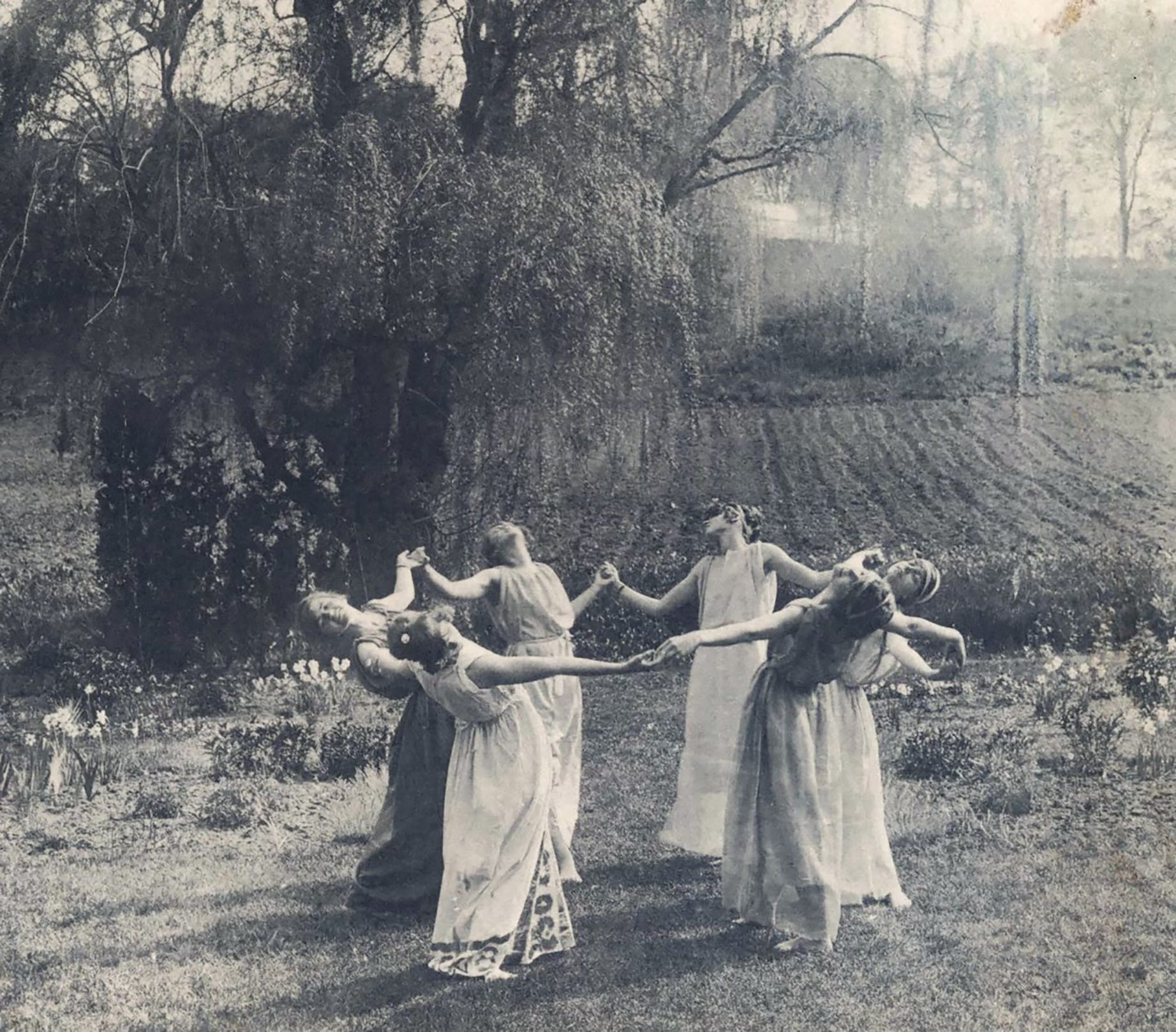
2. Turning and turning
In Anno Domini—A Short History of the First Millennium AD5, Laurent Guyénot explores theories that question standard chronologies. “The fact is that, for historians, the tenth century is a barrier beyond which it is difficult to see anything clearly.” There are problems with the dating and authentication of primary sources. He quotes Guy Blois from The Transformation of the Year One Thousand: 6
There was no gentle progress by imperceptible transitions from one situation to another. There was drastic upheaval, affecting all aspects of social life: a new distribution of power, a new relation of exploitation (the seigneurie), new economic mechanisms (the irruption of the market), and a new social and political ideology. If the word revolution means anything, it could hardly find a better application.
Guyénot describes it thus: “Sources of information from the tenth century are almost non-existent, and the sources from the eleventh century are not very explicit about the ills of the tenth century. The people of the early eleventh century lived with a sense of radical rupture . . .” (Anno Domini, p. 7) What happened during that period remains hidden behind documents manufactured in scriptoria. Nobody else was writing the past, either as forgery or attempted historical narrative.
There is no controversy in the claim that scriptoria falsified histories. Documents relating to donations of land were fabricated to provide apparent legitimacy to legal claims. An abbott could see off a bishop with a convincing cartulary. He could also appeal to a current monarch who might wish to better ground his throne on such documents. Fabrications became facts and history was made. Patrick J. Geary, in Phantoms of Remembrance: Memory and Oblivion at the End of the First Millennium, examines such deployments of manufactured documents.
Only in the first third of the eleventh century did Benediktbeuern once more become a monastery . . . The newly refounded monastery did not long maintain its independence. The bishops of Freising claimed control over Benediktbeuern . . . Under the direction of Abbot Gotahelm . . . a monk, Gottschalk, sought to defend the institution by anchoring its rights in the past. Gottschalk's vigorous if ultimately unsuccessful defence of his institution's independence led him to reconstitute Benediktbeuern's past, reaching behind the destruction and confiscations of the tenth century to the earliest period of his institution’s history.
(page 117)
Beyond the movements of celestial bodies, the seasons, and our own biological cycles, time, it seems, is a mechanism made to measure man. It counts his days. Yoked to clock time, its inevitability of seconds, minutes, hours, we are guided through our work. Those hands that turn the wheel can move clock hands as they wish. Chronologies are explained by current needs. There was a real order of events, but conveying this is not what history does. All we can say is that official chronologies are not true.
Knowledge of the past unlocks modernity. There is much that is false in received histories of the twentieth century. And that is important, because during periods described later as collapse, time is distorted and histories destroyed that new versions of the past might be created. If key aspects of the past are falsified, the entire present is false. For all of my life, that has been my reality. And it has been yours.
3. A voyage to Gaul
Rutilius Claudius Namatianus’ fifth century elegy on his journey from Rome, De redotu sou, linking abandonment of classical religion to Rome’s impaired condition, details the course of his journey.
I will travel by water because roads can flood
or be littered by slides and falling rocks;
Tuscany and the Aurelian Highway have
already fallen to the Goths. It is
best to trust the sea because the rivers are not
bridged and the land has become wild again.
The past, a garland still enjoyed by country people, is compared to the ignominy of an empire undermined. Rutilius does not admire monotheists, neither Christian nor Jew, who he blames for the chaos.
Before noon Faleria came into our sight.
On that day a fair was in progress and
the country people had come into town because
it was the day when Osiris wakes and
gives new life to the autumn seeds. We sought lodging
and strolled in a pleasant grove with small ponds.
There were fish in that water and we watched them play.
But we paid a high price for our short rest:
our host was harsher than Antiphates. He was
a miserly Jew, one of that strange race
who refuses to eat what is perfectly good.
The noises he made were quite unpleasant:
he charged us for damage to his plants and complained
about the amount of water we drank. 7
The shift here is from communal generosity to a life that must be accounted for. There is neither honour nor glory, and certainly no joy, in a world that turns to please the miser. Rome is compromised. He feels it through the manners, habits and beliefs of monotheists as through personal feelings of insecurity. Rome’s borders are broken. The highway is no longer safe. Compromise is apparent in coinage, which is debased. The denarius has become a form of fiat currency. Rutilius lived in inflationary times.
This is key: monotheism has corrupted Rome. Those directly affected withdraw from public life, become passive. They allow foreigners to occupy the heart of the empire. Discipline is abandoned, for there are easy ways out. Fiat currency, not money, is rooted in evil. Prone to weird cults, they insult the gods who protected Rome and its citizens. And so the gods fade from view and Rome is bewildered.
Disintegration summons titanic forces, which are collective and chaotic. Epic time emerges after that, but not at once and not for everyone. Most men must be forced into epic time. They will not admit the current reality until obliged by circumstance. Even then, some do not. False causes are easier to face. Thus we must reject what we are given. We must have our own leaders and they must lead for us, not for oligarchs or those who are uncynde.8 We require full-blooded gods, a folk king.
4. The operative aspect
Despite the weight of opinion to the contrary, poetry has nothing to do with self expression. Only in a world subverted could people believe this to be the case. Beyond what is borrowed, poetry has no personality. Through poetry impersonal forces enter mortal time. Encountered through form, image and rhythm, these forces indicate the presence of a god or company of gods.
When the time comes, song summons them. To put that another way, the coming poetic is operative in that it is egregorical. Joscelyn Godwin, in his book The Golden Thread9, explains:
There is an occult concept of the “egregore,” a term derived from the Greek word for “watcher.” It is used for an immaterial entity that “watches” or presides over some earthly affair or collectivity. The important point is that an egregore is augmented by human belief, ritual, and especially by sacrifice. If it is sufficiently nourished by such energies, the egregore can take on a life of its own and appear to be an independent, personal divinity, with a limited power on behalf of its devotees and an unlimited appetite for their further devotion. It is then believed to be an immortal god or goddess, an angel, or a daimon.
Godwin outlines the metaphysics:
One may deoccultize the theory of the egregore by imagining these entities to be mere energy patterns reinforced by use, analogous to the way in which patterns of neurons in the brain are reinforced and strengthened by use and mental effort. The formation of language is one example of how such a pattern may come to form the dominant matrix for our entire human experience. On the collective level, then, I suggest that the old Roman gods and goddesses did have a certain limited reality, and that they were kept alive by the beliefs of the people, the rituals of the priests and priestesses, and psychic energy released and directed in a myriad of animal sacrifices. So long as this compact continued, the egregores watched over the city, which flourished under their protection.
Precisely crafted, poetry is tradition. Uttered from the mouth as living leaves, it calls into being and becomes a physical, aesthetic and occult emanation. Felt in the rhythmic image, it is a chemical transformation of reality. Acting on its audience, it is metaphysical force. Initially limited in range, it grows. The precise image enters the unconscious aspect of the reader. Regardless of their opinions, prejudices or intentions, it works within them.
This is what I believe: That I am I. That my soul is a dark forest. That my known self will never be more than a little clearing in the forest. That gods, strange gods, come forth from the forest into the clearing of my known self, and then go back. That I must have the courage to let them come and go. That I will never let mankind put anything over me, but that I will try always to recognise and submit to the gods in me and the gods in other men and women. There is my creed.10
In addition to his creed, D.H. Lawrence describes the beginning of a creative process in which he is passive. He allows ingress from unconscious to conscious, but agency is with the gods. Those who are not poets can attempt to construct such a scenario by submitting to ritual, meditation, hypnosis or other enchantments, but in being consciously motivated at that stage, such activities may result in pretence.
Fiat culture, in approaching the spiritual realm, tends toward reenactment and parody. This because it is materialistic in nature, a poisoned void where culture ought to be. It is anti-culture. Thus the only weird thing about a gathering of neopagans, or of poetasters, is the aura of simulation that surrounds them. Gods forsake such vestibules. They prefer precise spelling, inductive grammar.
Power is deployed through the proper use of words. Poetry involves psychic objects being somatically expressed. Any amount of sensuous or rhetorical content can be included, and narrative, etc., but the operative aspect requires erudition. Imprecision is the enemy.
An ego affected by narcissism invokes an image of itself which, in appearing god-like, is demoniacal. There are numerous examples in the contemporary poetry world, but I will not invoke them. Instead I will focus on what we, over time, must do. Cycles play out according to many hidden aspects. We cannot leap into collective spiritual health. This is a lengthy working and the way is obscured by much bad poetry.
Upon entering Poesy, the inner spirit of the reader responds to a call from an unknown collective entity. This is located within, but they do not know what has altered them, nor from whence it comes. The experience, felt as strange, known to be meaningful, marks a turning point. Perhaps despite themselves, they respond.
5. Integral aspects
These days it is common for Westerners to believe that individualism and humanity are two words denoting one reality and that everyone everywhere is essentially the same. Of those who know this to be untrue, most have been convinced to try to pretend otherwise. I did that for much of my life. Obscuring all virtue, it inhibited understanding. This is what you get with ideology.
Poetry does not open a way back to good sense by convincing people. It cannot do that. Nor is poetry a badge of virtue. The opinions of the poet are as irrelevant as the opinions of his audience. Poetry doesn’t care if its author is a good bloke or a bastard.
Ezra Pound adjudicated:
. . . it takes a deal of talking to convince a layman that bad art is 'immoral'. And that good art however ‘immoral’ it is, is wholly a thing of virtue. Purely and simply that good art can NOT be immoral. By good art I mean art that bears true witness, I mean the art that is most precise. 11
We also get this in T.S. Eliot’s Four Quartets: 12
Since our concern was speech, and speech impelled us
To purify the dialect of the tribe
And urge the mind to aftersight and foresight,
Let me disclose the gifts reserved for age
To set a crown upon your lifetime's effort.
First, the cold friction of expiring sense
Without enchantment, offering no promise
But bitter tastelessness of shadow fruit
As body and soul begin to fall asunder.
Second, the conscious impotence of rage
At human folly, and the laceration
Of laughter at what ceases to amuse.
And last, the rending pain of re-enactment
Of all that you have done, and been; the shame
Of motives late revealed, and the awareness
Of things ill done and done to others' harm
Which once you took for exercise of virtue.
In its moment of realisation, the pain of re-enacting what we have never been is, perhaps, most acute. It is full shadow.
Little Gidding takes us into an unlit hinterland where one must lose everything and be emptied—literally, one becomes zero—in order to be filled for a moment. This is not ‘living in the moment’, it is a fleeting apprehension of past and future within a present which is illuminated by an image:
And what the dead had no speech for, when living,
They can tell you, being dead: the communication
Of the dead is tongued with fire beyond the language of the living.
Here, the intersection of the timeless moment
Is England and nowhere. Never and always.
In Poesy, I found the gulf between living and dead had been annulled. This is what it means to become true to your nature. Let others cast their own shadows.
This last point is important when considering the political aspect where virtue is essential. Making plain the relationship between poetry and the State, Pound defines the distinction:
Has literature a function in the state, in the aggregation of humans, in the republic, in the res publica, which ought to mean the public convenience (despite the slime of bureaucracy, and the execrable taste of the populace in selecting its rulers)? It has.
And this function is not the coercing or emotionally persuading, or bullying or suppressing people into the acceptance of any one set or any six sets of opinions as opposed to any other one set or half-dozen sets of opinions.
It has to do with the clarity and vigour of ‘any and every’ thought and opinion. It has to do with maintaining the very cleanliness of the tools, the health of the very matter of thought itself. Save in the rare and limited instances of invention in the plastic arts, or in mathematics, the individual cannot think and communicate his thought, the governor and legislator cannot act effectively or frame his laws, without words, and the solidity and validity of these words is in the care of the damned and despised litterati. When their work goes rotten—by that I do not mean when they express indecorous thoughts—but when their very medium, the very essence of their work, the application of word to thing goes rotten, i.e. becomes slushy and inexact, or excessive or bloated, the whole machinery of social and of individual thought and order goes to pot. This is a lesson of history, and a lesson not yet half learned.
The great writers need no debunking.
The pap is not in them, and doesn’t need to be squeezed out. They do not lend themselves to imperial and sentimental exploitations. A civilization was founded on Homer, civilization not a mere bloated empire. 13
The distinction between civilisation and empire is drawn along ethical lines. The ‘whole machinery of social and of individual thought and order’ has gone to pot. The ‘dialect of the tribe’ has never been so impure. It is the work of propagandists to keep it so, for they serve false gods.
At the macro level, epic time is prefigured. Lean gods displace bloated myth. And we see how war attends fiat collapse. We note mythic disturbances. The social aggregate is hyperreal. Everyone knows this is so, even those who, like ghosts, cling to a world they thought they knew. In the near term, one must look to kith and kin. We prepare for what is to come. We do not act out epic tropes or write them. Who would be our heroes?
6. A binding pledge
For poets, momentary clarity is handed over at the edge of an unlit hinterland. Later, whether writing or reading a poem, the nature of meanings found depends on willed activity and abandonment, force and submission. If one participates, one must do so fully. Poet conducts initiatory act. Reader receives a derivative of that, an elixir, which is in the poem. Both share the same enchantment.
Having accepted his gift, the poet must learn its implications. Acceptance is complicity. Whether one knows it or not, participation implies a vow, which poets take on. Bound to gods, as yet unknown, but felt, and to what we might call archaic kings and queens, or see as virtues personified as such, the poet is enchanted. He meets their servant on the edge of darkness. He accepts a gift. The gift is honoured in meanings made in acts of poetry.
The servant knows our ways better than we, who, in being long lost, have few memories and less knowledge and thus cannot find our way. Where the servant leads, there the soul shall dwell. But the gift must be honoured. The poet’s task is to make meaning viable again, to show through action what returning from ‘a raid on the inarticulate’ means (see T. S. Eliot, East Coker, Four Quartets). 14
Eliot’s conception of poetry, in being traditional, was far from mundane.
It is the poet’s business to be original, in all that is comprehended by “technique”, only so far as is absolutely necessary for saying what he has to say; only so far as is dictated, not by the idea—for there is no idea—but by the nature of that dark embryo within him which gradually takes on the form and speech of a poem. 15
That dark embryo, experienced as intrusion, a thrusting in of some other entity, is what Plato wanted to keep out of his ideal republic. This version of Eliot might appear to contradict the image of the conservative Anglo-Catholic public figure with which we are familiar but he, unlike Yeats, did not grapple with and seek to dominate these external forces, he merely accepted them. Eliot’s work contained prophetic elements, but he was no would-be magician.
In a poem which is neither didactic nor narrative, and not animated by any other social purpose, the poet may be concerned solely with expressing in verse—using all his resources of words, with their history, their connotations, their music—this obscure impulse. He does not know what he has to say until he has said it . . . He is oppressed by a burden which he must bring to birth in order to obtain relief. Or, to change the figure of speech, he is haunted by a demon, a demon against which he feels power-less, because in its first manifestation it has no face, no name, nothing: and the words, the poem he makes, are a kind of ... exorcism of this demon. In other words again, he is going to all that trouble, not in order to communicate with anyone, but to gain relief from acute discomfort; and when the words are finally arranged in the right way—or in what he comes to accept as the best arrangement he can find—he may experience a moment of exhaustion, of appeasement, of absolution, and of something very near annihilation, which is in itself indescribable. 16
Seeing radiance, I step forward. Called, I respond. Afterwards, I cannot grasp my experience. On returning, perhaps long afterwards, I see the gift watching from my poem. As if alive, the poem contains motion. Watching as I write, my poem works upon the world. That is the gift. I can use it or not. When the poem is made, people can read it or not. They can choose to hear it, or not.
In Poesy, I know, muses dance amongst the shades of poets long dead. Moving in circles, they turn the poem, which is their working. Breathing their breath, I conspire with them and become, temporarily, wraith-like. When Anne Boleyn walks within the action of my poem, I feel her hand in my mouth. She speaks in a flourish from my hand. In a gesture, graceful and profound, she tells me that I am what cannot be. That is, nothing. Hence nonism, which is nothing. So I am defined. 17
Homer’s epics were written at the end of a dark age. Chaos and confusion were receding into the past. Heart beating epic time, he lived within myth. None of us can claim anything even close to that. For us the shadows lengthen. Suffering is building. We were led into this wilderness. We allowed this. And now a vortex is cast upon us.
Those who stand the test may become hero and folk king of our epic. Who finds the mother lode, some future Homer, honours them. As weird and wonder, a single fatality, he embodies the quick and those who passed. I heard a great queen calling. Her garments gloaming, vision influent, past scintillant, skin lambent, she lights my way. Mater Memoriae, full of meaning. A certain orphic hero gleams in her eye.
Was there an age of bad lyric poetry in the lead up to the Greek Dark Age? I don’t know. But fine lyrics were to be found towards the end of the Roman republic. Catullus’ songs illuminate singularities we think of as modern. And there is something of the singularity in the approaching turbulence. Time becomes distorted in that unlit hinterland. 18
7. Vortex dancing
Writing epic poetry outside epic time is role play. Those who respect epic poetries of the past would not attempt to do this. There is no need. Epic time enters history through poetry. The early stages of epic mitigation are characterised by epic lyric emergent. Lyric imperilled plus an echo of the grandeur of the past. It breaks into and then erupts from collapsing lyric. Poetry always seeks an inflow of quintessence.
Epic lyric is transitional. Through temporal distortions the poet encounters images of future time and its past. We glimpse aspects of images from epics to come. Stored in the body, these are felt as instinct. Poet meets poem halfway. Epic lyric time is the first expression of a newly flourishing tradition.
Epic lyric grandeur, felt as the displacement of lyric time, registers much more than future sovereignty. Through it we encounter occult powers. Future gods intrude into collapsing lyric. We see them momentarily in ode fragments. We feel their resonance. We respond to them. Active below consciousness, rooted in our future past, they are epochal.
Sovereign aspects of tradition, informing landscapes, edging territory, imply egregores vitalised, enacted and unfolded, by those who live amongst their own kind. This is of the essence.
What I mean by tradition involves all those habitual actions, habits and customs, from the most significant religious rite to our conventional way of greeting a stranger, which represent the blood kinship of ‘the same people living in the same place’. ... We become conscious of these items, or conscious of their importance, usually only after they have begun to fall into desuetude, as we are aware of the leaves of a tree when the autumn wind begins to blow them off—when they have separately ceased to be vital. Energy may be wasted at that point in a frantic endeavour to collect the leaves as they fall and gum them onto the branches: but the sound tree will put forth new leaves, and the dry tree should be put to the axe.
T. S. Eliot 19
If we are to know ourselves we must breathe together. In our gatherings, there will be incipient gods.
Before there can be epic, which requires epic time, there must be epic lyric. Epic moments erupt through lyrical forms. In epic lyric images are yoked by violence together. This happens when the lyric voice becomes untenable. Lyric instability creates the conditions required.
Future actions gather in the past. Our ancient dead, reborn, suckle at the breast of memory. One growing through the coming storm gifts images, I find them in my poems. I feel them as other and thus I also am another. The strangeness of my poem makes me strange to myself. This is the grandeur of the epic lyric moment. The epic lyric poet, living through disordered times, walks with gods but does not know them. One caught my eye within the epic lyric vortex. The dancing theogonical matrix.
Poets must heed muses. Multi-phonic, their movements act upon the soul. Daughters of Memory, who is tomb and source, they dance upon her grave. Poem imago raised from a void. We do not see them passing through, but we know in retrospect where they have been. What they intend changes things and ill-formed verses make no offerings. Epic lyric, as described, is the efficacious oblation.
At the centre of the vortex, Homeric Orfeo.
He plays his tune. He wears his Golden Fleece.
8. Ideoplasty
The term idéoplastique was coined by Joseph-Pierre Durand, known as Durand de Gros, around 1860. In its original usage, ideoplasty described how hypnotic suggestion invokes change in its subject. It was later used by others to describe the process by which a spiritualist medium produces ectoplasm. In a wider sense, ideoplasty can be said to bring forth hidden forms, socially and so physically, spiritually and so politically. We have been trending into unreality for many years. Theurgic ideoplasty means a return to the real.
Ideoplasty sounds strange, but it is very common. The mechanism of mass media manipulation is ideoplasty. Hostile propaganda sets us working against our own interests. And hypnotic states are easily induced. Even pretending a trance state can put you into a real trance. The mass media has many in the West in a permanent trance state through which suggestions are dispensed. What are called psyops by those in the know are specific tactical operations. Most don’t notice the strategic level because we are in its unreality all the time.
A poet moves into and out of trance states. This to open unconscious aspects to the conscious faculty. We go into an unlit hinterland. T. S. Eliot calls this place ‘the inarticulate’. If one who encounters the resultant poem has the ability to concentrate, to become absorbed (i.e. they read, rather than go through the motions), then poetic imagery enters their unconscious aspect. The reader is illuminated from within. Access to meaning, where lost, is restored. This describes the task of the poet today.
The mechanism is outlined in Pound’s Guide to Kulchur. Here he relates episodes from his correspondence with a Japanese poet.
Katue Kitasono writes me:
"Now the most interesting subject to us is the relation between imagery and ideoplasty. Contemporary young poets are all vaguely conscious of, and worry about this. . . . anyone whose standing ground is in literature, can do nothing for it if he ignores the system of literature.
The formation of poetry takes such a course as:
A. language B. imagery C. ideoplasty
That which we vaguely call poetical effect means, generally, ideoplasty which grows out of the result of imagery.” 20
Pound quotes this from Kitasono on page 139:
The phenomena in our life proceed, through our senses to our experiences, perceptions, and intuitions. It is intuition rationally that provides the essentials for imagery, and it is the method of poetry that materializes intuitions perceptively and combines. Consequently, exact imagery and ideoplasty are due to an exact method. Pure and orthodox poetry cannot exist without this theory.
This is how I see it:
The poet submits to a force emergent within, that which Eliot refers to as a ‘dark embryo’. This force is born through imagery. The reader, induced by encounters with such imagery, is reunited with the essence, which is collective. One reader at a time, the group becomes conscious of itself. The organism develops operative will. It becomes active.
Direction comes from the organism, which is collective, natural and native to its land. The land is a living part of the organism. Images arising from landscapes we love nourish us. Hence attempts by those who control the State to deface or render inaccessible landscapes that empower and encourage natives. The group is exclusive, as is the land. In terms of meaning, these things are discrete and cannot be made accessible to outsiders.
Demoralised, the organism has been fragmented. As we were isolated, the violence of this process gradually increased. But it is at this point that upheaval occurs within the unconscious aspect of the organism. What was silenced is now expressed.
This about harmonics. Like attracts like. Each sees kindness in the other. An individual soul resonates with similar energies. That is natural. We are at home with our own kind. If you react against nature, it is because of hostile conditioning. Regardless of this, nature finds a way.
9. Epic approaches
People might say they can do this without a new poetic, that poetry is irrelevant. I say, other art forms are important, but only poetry fully articulates that which is collectively figured. Image defines symbolic content precisely using the technology of poetry, which is language. Thence ideoplasty and the creation of meaning. 21
After ideoplasty, meanings found in poetry can be understood and discussed. They can also be expressed in other art forms, precisely for those who are trained or initiated, but not with precision open to all. Once released, essential force cannot be contained. It appears everywhere. It proliferates itself.
Such a process cannot be scaled-up using party politics because only controlled opposition can participate. It cannot be achieved by reclaiming the streets for similar reasons. Political groups, for self protection, have manoeuvred into outreach and community building. But the image they present is defaced before it enters mass media representation.
Official poetry represents a State beholden to oligarchs. In the UK that power is wielded from within the City of London. Official poetry does not proliferate. It can only recruit more bureaucrats. Meanwhile, despite all this, significance emerges elsewhere. When the collective soul moves, we all move as one. Unity comes from a binding of souls. Of the possible etymologies of religion, one is “to bind fast” another is “bond between humans and gods”.
The conditions of modern popular art are so degrading that no man of determined or distinguished mind can possibly adopt them. “What the public wants” are the stale ideas of twenty, or fifty, or even seventy years ago, ideas which any man of talent rejects at once as banal. It is only the cliché, only the stale, the flat, and the profitable in art which finds ready acceptance and eager purchasers; while the exploiters at third hand of original ideas are the only innovators to secure applause. 22
Things have got worse since Eliot’s day. There is now a ‘poetry scene’, which is a vast and repressive bureaucracy. Its task is to come between us and the dead. Whether mainstream or innovative, Oxford or Cambridge, bureaucracy corrupts and differentiation is measured in degrees of self-conceit. Malice, Delusion and Vanity. They are zombies attempting to devour an ideal. That also applies to patriots marching epic tropes ahead of time.
In an article that might be described as ‘blood and soul mysticism’, whilst commenting on the postmodern offer of “bloodless soul, or soulless blood”, Laurent Guyénot identifies what is happening. Here he quotes from Jean Delumeau and Jean Baudrillard.
Christian apologists claim that Christianity contributed to the progress of civilization by “transforming ‘archaic societies’ into ‘metaphysical societies’ that accept the idea of a radical separation between the living and the dead.” I doubt if building a wall between the living and the dead has made us more civilized. I think there is more truth in Jean Baudrillard’s point that, “shattering the union of the living and the dead, and slapping a prohibition on death and the dead [is] the primary source of social control.” 23
Guyénot compares contemporary Christian ontology with that which emerged from Darwinism and finds them to be two sides of one coin. European Christianity, in its archaic phase, had Greek and gothic elements. There was no judaeo prefix. That didn’t get bolted on until the twentieth century. If we are polytheists, our gods are Greco-gothic. If we are monotheists, our He is Greco-gothic too. In truth, putting the One above the many, we tend to include pantheon and Sky-Father in our metaphysic.
It is tempting to see the counterfeit called ‘poetry scene’ as an iteration of the same ontological fraud. It also is concerned with social control. To function at all, a poetic must involve the dead. Without them, there is no meaning. High modernism included the numberless dead in its poetics. Postmodernism removed this most vital aspect. Thus the absence of spirit, the endless reenactment of the same ‘experiment’. ‘Bloodless soul’ describes the being of the mainstream warbler. ‘Soulless blood’ sums up the living death of self-styled innovators. All are part of one thing. Emptiness in place of essence.24
Through self promotion, conformity and grovelling, those Eliot called ‘popular charlatans’ invest in what poetry is not. Poetry needs no acclaim from Ponzi scheme enjoyers. A poet provides access to the essence through discrete parley with those who guard it. We might meaningfully think of the Golden Fleece as its symbol.
Meanwhile, the largest credit bubble in history is imploding. Time disaggregates, becomes distorted. For those who are observant, it happens in slow motion. Others, who feel it but don’t want to think of it, will remember this as sudden and unforeseen.
In response to a Substack article by David Jensen, I left this comment:
T. S. Eliot wrote of the objective correlative. He was referring to the object behind a metaphor. If it wasn't fully there, in the real world, the metaphor didn't work. The same principle applies here. The London promissory note precious metals market is now revealed to be a failing metaphor, which means we can see that its object is not present. Bad poetry affects everyone, even those who do not know of its existence, and in the case of this market it has undermined what we used to think of as ‘reality’ (my air quotes are not hostile, I am cuddling that word). For me, with my interest in poetry and the laws of nature, this is more than just interesting. Those who control what we have been led to think of as money have made us sick in many ways. The effects of this range from poverty, debt, mental ill health, demoralisation and despair, the premature deaths of individuals and, as we all witness, civilisational collapse. In my opinion David Jensen and others point to what might be the only effective and humane remedy: it is time for money markets to get physical. I hope that we are seeing the return of the objective correlative. This is akin to a god stepping from its realm into ours and unifying them. I look forward to further revelations. 25
All credit bubbles burst and the current implosion, distorting time, will overwhelm individuals. Many, unprepared, will seek help from State agencies and thus will be compromised. If there are goodly wonders, they will come from us. From our collective spirit, our greco-gothic gods. Others, obliged to accept official narratives, will hear much of ‘lessons learned’ but little of those who are exempt from criticism. Every aspect of the ground has been prepared. 26
In terms of culture, and whatever your susceptibilities, do not add to the unpoetry cluttering up the place. Attempting what you cannot do misallocates resources and that is typical of fiat time. You cannot be what you are not and you cannot decide to be a poet. The good you can do comes from who and what you are and the skills you have learned. A little bit of understanding goes a long way. If you find yourself praising bad poetry because you agree with the opinions expressed by its author, please stop.
Coda
In this exposition, I refer to ideas expressed by pre-Second World War poets and not to those who followed. It is my belief that with the defeat of European peoples in that war, an attempt was made by the victors to obscure the poetic tradition, the Great Tradition, of our people. This to precede our physical annihilation. Ezra Pound was imprisoned in a mental institution. Eliot became cloistered. The tradition lived on through the work of David Jones. He was sidelined. Not that he cared.
Tradition, coiling through Basil Bunting’s Briggflatts, gave us epic glimpses, but only David Jones sat in the forbidden chair. This, his Siege Perilous, required sacrifice. Thus seated, his body was a living sign of what had been broken. Then came Geoffrey Hill (see note 4 below, ‘The individualised self disintegrates’). Importantly, Hill acted as a reminder. He kept the living link alive. After that, nothing.
The Left would point to Charles Olson. Of the few poets that I have corresponded with in recent years, one described Olson’s major work, Maximus, as ‘notebook jottings’. Its vast bulk merely eclipses what had preceded it. Now poet has been commodified and anyone can buy it to be it. Consumerism appears to have destroyed the tradition.
Although unseen, it moves beneath the boys and girls processed through the ‘innovative poetry sausage machine’ (as a friend of mine called it). And it is the case that these days, universities are machines for killing poetry. They come between us and the dead. And from that the endless attention seeking, the whoring, exploitation and kowtowing. Everything is bought and paid for. All is vanity and corruption. In terms of poetry, the ‘big names’, who appear as beneficiaries, are not worth mentioning.
The hour is late. Those who murdered poetry celebrate participation, inclusion and diversity, for these are the preliminary blood rites of communism. It is the end of a great cycle and they are victorious. They have insulted and banished the dead. Nothing can prevent what they desire. Each pushing others aside, gaining the centre, they see a corpse, propped atop a bonfire, seated in an old wooden chair. It opens its eyes.
Epic lyric is epic mitigation.
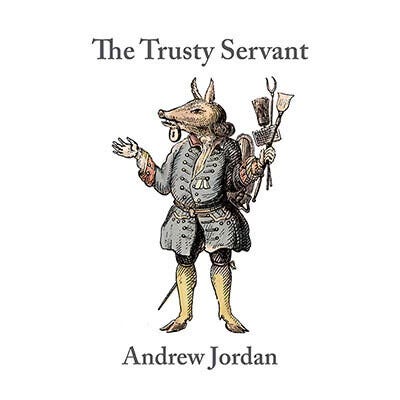
Published by Shearsman Books in 2022, The Trusty Servant
is Andrew Jordan’s most recent poetry collection.
Paperback, 72pp, 8 x 8ins, £12.95 / $20
ISBN 9781848618442
Various buying options are listed on this page.
The Trusty Servant - Back cover text:
I chanced to see Old English verse in paragraphs like prose, obsolete characters redolent of atmospheres we are no longer encouraged to admit. An ancient tradition, reaching beyond us into new forms, frames what we might hand over or betray.
The status of the Underground as an ‘imagined village’ where everybody knows each other has brought about stability – and compromised the forward dynamic written into its charter. This describes, at least vaguely, the role of the malcontent. No-one is more malcontent than Jordan. . . . To speak seriously of ‘hegemony’ challenges the warm identification between writer and reader which is the attraction of poetry for so many readers. It launches a critique of participation.
Andrew Duncan, A Poetry Boom 1990-2010
Must we conform to the current state of poesy, and thus trade in cosy arrangements, or might we say instead that now the truth of poetry is vital and endangered? When the answer to that question is in doubt, the time has come to find a Trusty Servant.
The Trusty Servant © Andrew Jordan 2022
I toyed with the enormity of using this much larger column of Canto LXXXI as my epigram:
First came the seen, then thus the palpable
Elysium, though it were in the halls of hell,
What thou lovest well is thy true heritage
What thou lov’st well shall not be reft from thee
The ant’s a centaur in his dragon world.
Pull down thy vanity, it is not man
Made courage, or made order, or made grace,
Pull down thy vanity, I say pull down.
Learn of the green world what can be thy place
In scaled invention or true artistry,
Pull down thy vanity . . .
. . .
“Master thyself, then others shall thee beare”
Pull down thy vanity
Thou art a beaten dog beneath the hail,
A swollen magpie in a fitful sun,
Half black half white
Nor knowst’ou wing from tail
Pull down thy vanity
How mean thy hates
Fostered in falsity,
Pull down thy vanity,
Rathe to destroy, niggard in charity,
Pull down thy vanity,
I say pull down.
But to have done instead of not doing
this is not vanity
To have, with decency, knocked
That a Blunt should open
To have gathered from the air a live tradition
or from a fine old eye the unconquered flame
This is not vanity.
Who was Blunt?
Wilfred Scawen B, 1840-1922, poet, diplomat, politician, world traveler, and defender of home rule for India, Egypt, and even Ireland, for which he became the first Englishman to go to prison. In the London years, Pound thought highly of Blunt and sent some of his poetry to Harriet Monroe, saying, ‘the Blunt stuff, glory of the name etc. ought to build up our position...’ [L, 34]. . . . In “Homage to Wilfred Blunt” Pound wrote about Blunt’s double sonnet, “With Esther”: “Mr Blunt is about the last man who has been able to use the old-fashioned Elizabethan ‘grand style’ effectively” [Poetry, vol. 3, no. 4, 220-223]. These impressions flooded back over 30 years later. Blunt was a man of action who with a fine old eye helped create “a live tradition.”
Quoted from: A Companion to the Cantos of Ezra Pound (Carroll F. Tyrell, University of California Press 1993)
President Trump does not evidence the arrival of epic time. His emergence indicates that we are deep into the prepping phase.
Although feminised men cannot create epic worlds, I am not saying that lyric is feminine and epic masculine. Poetry is a masculine art. Exceptions to the natural order prove its rule. Poets—including the most feminine—must develop ‘negative capability’ (Keats). Whilst honouring unconscious powers as motive force, they learn conscious artistry. In courtly manner, a poet husbands the all powerful mother of the Muses, Queen Memory. Art, the sovereign element, is her adornment. If we think of the masculine element as rider and the feminine as horse, we have the conscious riding the unconscious to a destination that is revealed along the way. This is an image of the poet at work.
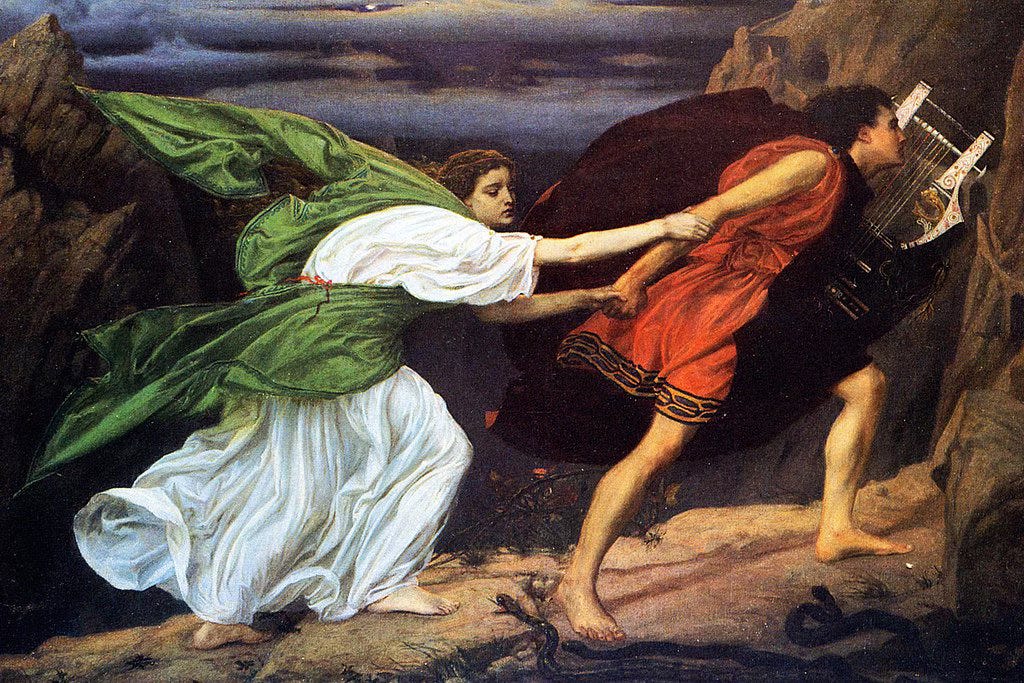
Orpheus overcame sirens. Epic overwhelms lyric, but not until lyric is exhausted. Each has its moment. Epic leans through disordered lyric and makes itself known. Gods watch from within epic lyric poetry. The epic lyric moment is transformative. This process is cyclical. As the stars turn, so too poetry.
The works of Geoffrey Hill illustrate this. Mercian Hymns (1971) presented Hill as a possible embodier of tradition in a time of dissolution. I say possible because he was canny and would dodge the role. It had become untenable. And that realisation of poetry being in crisis, along with the civilisation that formed it, that it formed, shaped the dynamic in his work for the next fifty years. Hill’s embodiment of tradition required too much irony. His work appeared to seize up. After that, poems burst into the world. A rapid series of books appeared at the end of his career, with each perhaps representing a different facet of what had exploded. A poetic fragmentation grenade, his final collection, The Book of Baruch by the Gnostic Justin (2019), carries a monumental charge, but its moment is shattered. Hill was reborn after being prescribed Prozac. Then the grenade went off. Prozac pulled the pin.
David Jones (1895-1974) was perhaps the last poet to embody the tradition. He remains the greatest British poet of the 20th century. He wore the garland, despite the cost. The chair he occupied remains vacant to this day.
Laurent Guyénot, Anno Domini - A Short History of the First Millennium AD
https://www.amazon.co.uk/Anno-Domini-Short-History-Millennium/dp/B0BZF9RJ25
Guy Blois, The Transformation of the Year One Thousand: The Village of Lournand from Antiquity to Feudalism (Manchester University Press 1992)
The quote is on page seven of Anno Domini (see note 5).
Quoted from The Last Poets of Imperial Rome, translated by Harold Isbell (Penguin Classics 1971).
Who was Antiphates?
Antiphates: a king of the Laestrygones in Sicily. When on the seventh day after leaving the island of Aeolus, Odysseus landed on the coast of the Laestrygones and sent out three of his men to explore their country, one of them was immediately seized and devoured by Antiphates, for the Laestrygones were more like giants than men. They now made an attack upon the ships of Odysseus, who escaped with only one vessel. (Hom. Od. 10.80-132.)
A Dictionary of Greek and Roman biography and mythology (1848), William Smith, Ed.
uncynde
Middle English unkind, from Old English uncynde “unnatural, not in accord with the regular course of nature” (a sense now obsolete); see un- (1) “not” + kind (adj.).
Joscelyn Godwin, The Golden Thread (Quest Books 2007), pages 50-51.
Literary Essays of Ezra Pound, Edited with an Introduction by T.S. Eliot (Faber and Faber 1954), page 44.
Literary Essays of Ezra Pound, Edited with an Introduction by T.S. Eliot (Faber and Faber 1954), page 21.
T.S. Eliot, quoted from The New Poetic, N.P Stead (Hutchinson University Library 1964), pages 135 -136.
Ibid. Page 143.
“A Poet is the most unpoetical of any thing in existence; because he has no Identity - he is continually in for—and filling some other Body—The Sun, the Moon, the Sea and Men and Women who are creatures of impulse are poetical and have about them an unchangeable attribute—the poet has none; no identity—he is certainly the most unpoetical of all God's Creatures. If then he has no self, and if I am a Poet, where is the Wonder that I should say I would write no more? Might I not at that very instant have been cogitating on the Characters of Saturn and Ops [Saturn's wife]? It is a wretched thing to confess; but is a very fact that not one word I ever utter can be taken for granted as an opinion growing out of my identical nature—how can it, when I have no nature?”
John Keats, letter to Richard Woodhouse October 27th, 1818.
Stephen Spender, in The Struggle of the Modern (University of California Press 1963), gnawing at concepts of tradition, attempting to define “what was essentially modern”, saw only facets as the vortex turned. Putting his comments on the nature of momentary modernism together produces an odd effect, something like cubism (see below).
Misremembering his words, I mutated his attempted definition into this: ‘The whole of the present and the whole of the past as a single fatality.’ That defines poet working within an image.
Here is what he actually said:
. . . the vision of the present confronted by the past as a single total experience. The vision of a whole modern world—a whole fatality—related to a past which is also whole, if only in not being modern, is, let me emphasize again, essentially the characteristic of the modern.
p. 94
The faith of the moderns is that by allowing their sensibility to be acted upon by the modern experience as suffering, they will produce, partly as the result of unconscious processes, and partly through the exercise of critical consciousness, the idioms and forms of new art. The modern is the realized consciousness of suffering, sensibility and awareness of the past.
p. 72
If we consider ourselves as belonging not just to our own particular moment in time but also to the past, then we must also be fully aware of our predicament which is that of past consciousness living in the present. The modern is the past become conscious at certain points . . . the modern in his work is occupied with trying to bridge a gulf within his own awareness, of past from present.
p. 78
T.S. Eliot, After Strange Gods—The Page-Barbour Lectures at the University of Virginia 1933 (Faber and Faber 1934, Facsimile edition by Alpha Editions 2020)
Ezra Pound, Guide to Kulchur (Faber & Faber 1938) p137
“The primary arts of the Renaissance were visual—painting, sculpture, and architecture. Those of the Romantic era were aural—poetry, imaginative prose, and music. The latter arts act as a more powerful stimulus to the inward path because of the different functions of the eye and the ear. The eye gives us immediate and detailed knowledge of the physical world surrounding us; it draws us out of ourselves, so much so that most people forget that they are even there. The ear also draws us, but not so much out of as into ourselves. We always have to interpret what we hear, because it comes through language rather than with the immediacy of forms and colors. When we read poetry, and even more when we hear it spoken, it causes images to arise from inside, rather than from without. We create and own them in a way that we can never do with the outside world.”
Joscelyn Godwin, The Golden Thread (Quest Books 2007), pages 127-128.
T.S. Eliot, quoted from N.P Stead, The New Poetic (Hutchinson University Library 1964), p. 98.
Guyénot quotes from two sources:
Christian apologists claim that Christianity contributed to the progress of civilization by "transforming 'archaic societies' into 'metaphysical societies' that accept the idea of a radical separation between the living and the dead.” [1] I doubt if building a wall between the living and the dead has made us more civilized. I think there is more truth in Jean Baudrillard's point that, "shattering the union of the living and the dead, and slapping a prohibition on death and the dead [is] the primary source of social control." [2]
[1] Jean Delumeau, La Peur en Occident (XIVe-XVIIIe siècles). Une cité assiégée, Fayard, 1978, p. 82.
[2] Jean Baudrillard, Symbolic Exchange and Death (1976), SAGE, 2017, p. 150.
I quote Guyénot from here:

This also is contained within Do the Ghost Dance:
“And as long as there was a blood aristocracy, blood ideology endured. At its core, wrote French medievalist Georges Duby in The Knight, The Lady, and the Priest, was “probitas, a valor of body and soul that produced both prowess and magnanimity,” and “was transmitted through the blood.” Marriage, which until the tenth century evaded clerical control, “was to unite a valiant progenitor to a wife in such a manner that his legitimate son, bearer of the blood and name of a valorous ancestor, should be able to bring that ancestor to life again in his own person.” Mothers contributed just as much as fathers to the quality of their offsprings’ blood. That ideology persisted not thanks to Christianity, but in spite of it, and Duby’s book tells the story of its siege and ultimate surrender to the Gregorian papacy.”
See: Georges Duby, The Knight, The Lady, and the Priest: The Making of Modern Marriage in Medieval France, Pantheon Books 1981.
The reference to meaning is important and should be emphasised. Meaning means action. That isn’t some kind of a command, it means that people with meaning can act because they can see a way. In the absence of meaning there is no meaningful action, just, at best, random units going nowhere. Meaning is of the essence.
Conjoining with ancestors involves limitless depth of meaning. Here we find the mother lode. When we are ready she calls us to it, personally. She calls us to ourselves, through herself, personally.
In my comment, ‘physical’ refers to the monetary metals, especially gold. Currency quickly becomes poisonous unless fully backed by its natural objects, which are silver and gold.
In terms of individual behaviours, we will better survive the coming crisis by exchanging credit (fiat currency) for silver and gold. That and growing food and buying directly from farmers. We need to be as independent as possible.

David Rogers Webb, The Great Taking (2023). “ . . . a book written about the scheme of central bankers to subjugate humanity by taking all securities, bank deposits, and property financed with debt.”
You can buy the printed book or download it as a PDF here.
The paperback is available for the cost of production: £9.99.
Order it from lulu.com here.
There is a documentary film here.
The author is involved in attempts to persuade various US state legislatures to abrogate from legislation put in place covertly. See this video for news of how that is going.